
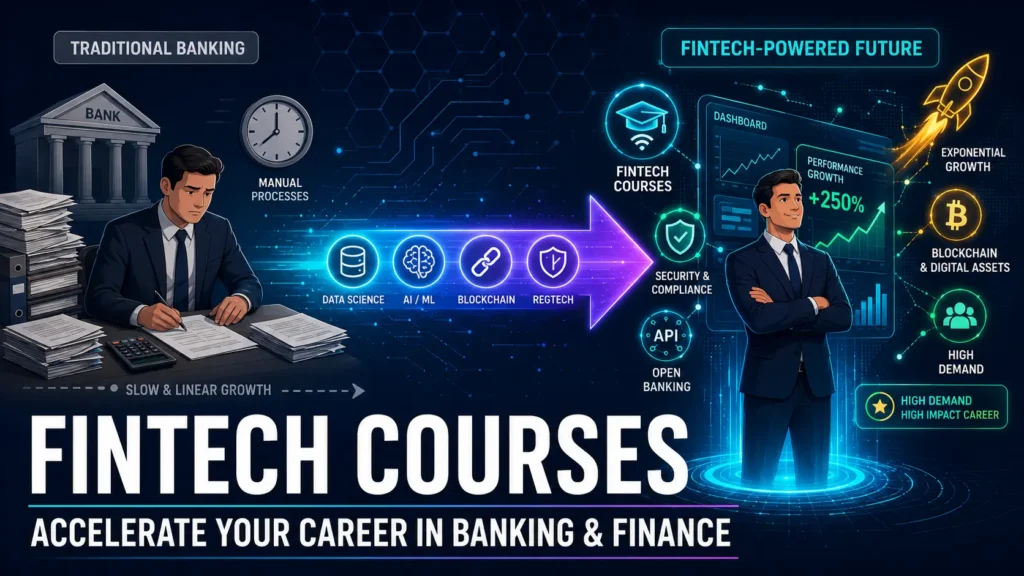
The traditional banking and financial services sector is undergoing a massive, irreversible digital transformation. The line that once clearly separated a “finance person” from a “tech person” has completely blurred. Global financial ecosystems are now driven by autonomous AI agents, multi-rail real-time payment infrastructures, decentralized blockchain ledgers, and embedded open banking APIs.
According to global financial research, market trends highlight that purely operational, manual back-office roles in banking are rapidly declining due to automation. Conversely, demand for tech-savvy financial professionals—those who understand both market economics and digital product architecture—is exploding.
For students, mid-career professionals, and traditional bankers, upskilling via specialized Fintech courses is no longer just an option to boost a resume; it has become a mandatory career survival strategy. This comprehensive guide details exactly how structured Fintech education can aggressively accelerate your career velocity, the core skills you must acquire, and the highest-paying roles waiting for certified talent.
1. The Shifting Paradigm: Why Traditional Finance Is No Longer Enough
Historically, a successful career in banking or corporate finance required a mastery of accounting principles, financial modeling via Excel, macroeconomics, and traditional risk assessment frameworks. While these foundational concepts remain critical, they are no longer sufficient on their own.
Modern legacy institutions and agile Neobanks do not just process data; they build automated scale.
- The Problem: A professional who can manually calculate a credit score or audit a ledger provides linear value.
- The Fintech Solution: A professional who can write a script to pull alternative data points via APIs, feed them into an automated machine learning credit-scoring model, and manage algorithmic risk provides exponential value.
Fintech courses bridge this exact gap. They take your existing knowledge of finance and supercharge it with modern technological frameworks, transforming you from a transactional worker into a high-value systems architect.
2. Core Technical Domains Covered in Modern Fintech Courses
A premium, comprehensive Fintech program goes far beyond superficial buzzwords. It provides rigorous training in specific engineering, analytical, and governance disciplines. When choosing a Fintech certification, ensure the curriculum dives deep into these four foundational pillars:
[Financial Data Science] ➔ [AI & Automated Operations] ➔ [Blockchain & Programmable Money] ➔ [RegTech & Governance]
A. Financial Data Science & Predictive Analytics
Data is the lifeblood of modern finance, but raw data is useless without structure. Fintech courses teach you how to extract, clean, manipulate, and visualize massive financial datasets.
- Key Languages & Tools: Python, SQL, R Programming, Tableau, and Power BI.
- Practical Application: Automating standard back-office reporting, building algorithmic trading engines, and performing predictive analysis on customer churn rates.
B. Artificial Intelligence (AI) and Machine Learning in Banking
Artificial intelligence has transitioned from basic automated chatbots to fully autonomous execution. Financial institutions are leveraging AI to automate transaction reconciliation, flag anti-money laundering (AML) anomalies in real-time, and run predictive cash forecasting.
- What You Learn: How to deploy, evaluate, and manage Large Language Models (LLMs) and predictive neural networks specialized for high-throughput financial environments.
C. Blockchain, Tokenization, and Digital Assets
Tokenization is moving from conceptual hype to institutional infrastructure. Major asset managers and investment banks are actively converting real-world assets (RWA)—such as corporate bonds, real estate, and private equity funds—into programmable digital tokens on decentralized ledgers.
- What You Learn: Smart contract mechanics, decentralized finance (DeFi) liquidity pools, stablecoin cross-border payment rails, and institutional digital asset custody solutions.
D. Open Banking, APIs, and Embedded Finance
Embedded finance integrates financial products (like loans, insurance, or instant payment processing) directly into non-financial applications (such as e-commerce platforms or vertical SaaS tools).
- What You Learn: How Application Programming Interfaces (APIs) securely share financial data between traditional banking core infrastructures and third-party developers, unlocking brand-new monetization models.
3. Strategic Career Pathways Accelerated by Fintech Education
By completing a certified Fintech program, you unlock career paths that offer faster promotion cycles, higher equity options, and significantly greater compensation packages than traditional corporate ladders.
Pathway 1: Quantitative Analysis & Algorithmic Trading
Quants combine financial theory with complex computer modeling to execute high-frequency trades and manage multi-billion dollar portfolios.
- Fintech Catalyst: Courses providing Python and C++ logic modeling give you the baseline skills required to build algorithmic trading systems.
- Earning Potential: Senior quantitative engineers regularly secure some of the highest total compensations in the tech and finance sectors combined.
Pathway 2: Fintech Product Management (PM)
Product Managers act as the absolute bridge between software engineers, UI/UX designers, compliance lawyers, and executive business stakeholders. They define what a digital financial product will do and how it will generate revenue.
- Fintech Catalyst: A structured course teaches you how to design human-centered financial user interfaces (UX/UI), draft clear technical product requirement documents, and safely manage API logic loops.
Pathway 3: Automated Risk Management & Fraud Analytics
Traditional credit and risk management relied on historical data patterns and manual audits. Today, automated risk control screens documents, evaluates real-time behavioral biometric patterns, and stops cyber-fraud before a transaction settles.
- Fintech Catalyst: Enrolling in programs focused on data analytics allows you to run complex “what-if” macroeconomic simulation matrices, proving a bank’s resilience to sudden systemic shocks.
Pathway 4: RegTech & AI Governance Leadership
As AI agents and automated tools take over financial decision-making, global regulators (such as the SEC, CFPB, and European monetary supervisors) are enforcing strict audit rules. If an algorithm makes a biased lending decision, the bank is held legally liable.
- Fintech Catalyst: Fintech governance courses specialize in model validation, data transparency, and algorithmic compliance, preparing you to lead critical corporate risk mitigation divisions.
Traditional vs. Fintech-Driven Career Trajectories
| Metric / Feature | Traditional Banking Path | Fintech-Accelerated Path |
|---|---|---|
| Core Skillset | Excel modeling, manual auditing, relationship management. | SQL/Python, API management, automated workflow design. |
| Operational Speed | Batch-based systems, lengthy manual approvals. | Real-time automated flows, instant settlements. |
| Career Progression | Linear, tenure-based promotions (Slow). | Meritocratic, skill-based scaling (Ultra-Fast). |
| High-Demand Roles | Credit Analyst, Branch Manager, Traditional Auditor. | Product Manager, AI Risk Lead, Algorithmic Quant. |
| Starting Compensation | Standard entry-level corporate scale. | Premium tech-bracket scaling with performance equity. |
4. How Fintech Certifications De-Risk the Career Transition
Transitioning from a traditional professional background into a cutting-edge technology space can trigger intense imposter syndrome. Fintech courses serve as an active de-risking mechanism in three distinct ways:
1. Hands-On Portfolio Generation
Top-tier Fintech courses do not evaluate your competency based on multiple-choice memory exams. Instead, they require you to construct a comprehensive capstone portfolio. When applying to elite digital brands like Stripe, Revolut, Airwallex, or Plaid, displaying a verifiable GitHub repository containing live code that pulls transactional records via public APIs carries infinitely more weight than a basic resume description.
2. Immediate Networking and Institutional Access
Premium academic institutions and bootcamp providers partner directly with industry leaders. Enrolling in these courses introduces you to active, working peer networks, dedicated career coaches, and exclusive hiring portals hosted by venture-backed startups and elite financial companies looking for pre-vetted talent.
3. Immediate Domain Specialization
Instead of competing against thousands of generic computer science graduates or standard MBA applicants, a Fintech specialization positions you perfectly inside a highly specific corporate niche. You understand the complex regulatory guardrails (such as KYC, AML, and data privacy frameworks) that standard programmers know nothing about, while possessing the tech-fluency that traditional business majors lack.
5. What to Look For When Selecting a Fintech Course
Not all certifications are created equal. The market is saturated with low-effort video courses that provide little real-world value. To maximize your financial return on investment, evaluate your educational provider using these four rigid criteria:
- Audited Employment Statistics: Check if the program is verified by independent reporting bodies or if they transparently publish their graduation-to-employment placement ratios.
- Live Practice Labs: Avoid courses that are entirely theoretical. Ensure the curriculum includes real sandbox testing environments where you can safely construct and execute mock payment requests or query financial databases.
- Active Industry Practitioners: Verify that your modules are designed and instructed by active engineers, senior product managers, or quantitative leads working inside modern tech ecosystems, rather than career academics.
- Regulatory & Compliance Modules: Technology without compliance is dangerous in finance. A valuable course must dedicate substantial instruction to open banking directives (like PSD3), digital infrastructure resilience (like Europe’s DORA), and cross-border digital compliance frameworks.
The financial landscape is evolving at a staggering pace. Traditional banking models are consolidating, and infrastructure is modernizing globally. Standing still in today’s job market is equivalent to moving backward.
By strategically enrolling in a comprehensive, tech-heavy Fintech course, you actively take control of your professional trajectory. You stop being a passive user of financial software and become the valuable expert who designs, automates, and manages the next generation of global money movement.
Map out your learning path, pick your technical specialization, and begin building your digital finance portfolio today to secure a highly profitable, future-proof career!
